
Charlotte Gibson: a story 100 Years in the making
Ageing with fire in her belly
Written by CEWH Kaihautū Dr Kathie Irwin (Ngāti Porou, Rakaipaaka, Ngāti Kahungunu), this is the story of Charlotte Gibson (Ngāti Oneone), of whenua, whakapapa, leadership and determination - and it’s a story 100 years in the making.
Charlotte, Chair of Ngāti Oneone and Te Poho o Rawiri Marae, a Te Kōhanga Reo kaumātua and Kapa Haka champion, is a strong, active and vocal iwi and hapū leader. In 2025, she led Ngāti Oneone on a 174-day “Reclamation of Whenua” movement.
At the end of those 174 days, Ngāti Oneone secured the return of several land titles on Hirini Street in Gisborne.
For CEWH, this is also a story about coming closer to the ground - sitting with people, listening and connecting our research - our data - with what was happening locally.
And it’s a story that asks what happens when an older Māori woman who is carrying the memories of her beloved parents, Tokorua and Rawinia Te Kani, her hapū and her tīpuna, decides that the history she inherited will not determine the future her mokopuna inherit.
As Aotearoa moves closer to “move-on” orders, which will have a disproportionate impact on Māori, Charlotte’s story reminds us that colonisation is not simply history - it mutates and continues to shape Māori lives in ways wider society may not see.
This is Charlotte Gibson: aging with fire in her belly, getting better with age.
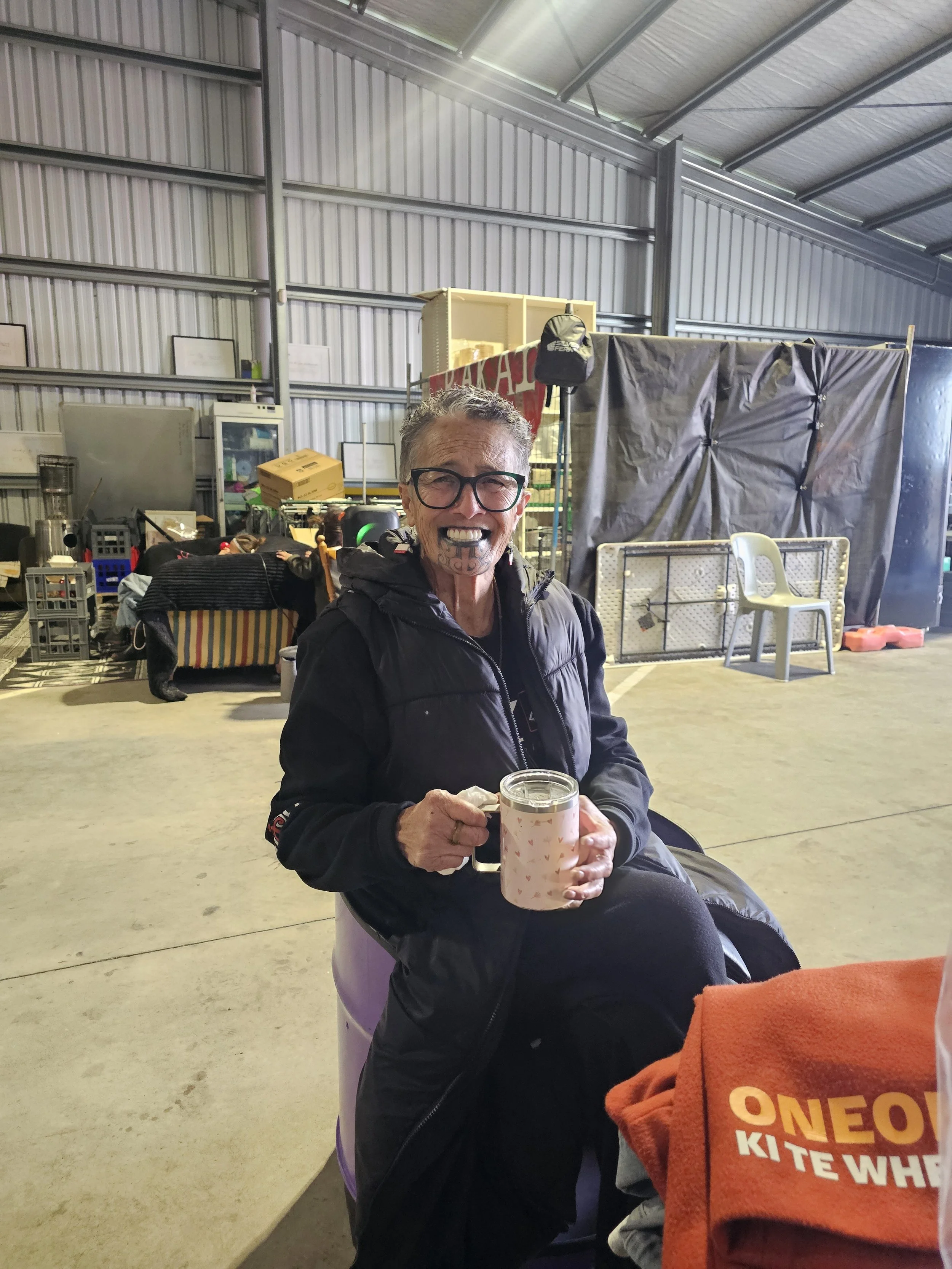
Late on a Saturday night, after a narrow All Black test win over France at the new Te Kaha Park in Christchurch, I had a quick check-in on Facebook before turning in for the night.
Up popped Char on my feed, doing a live promotion of the Sunday morning market at Te Pā, in Hihiri Street - the site of the Ngāti Oneone occupation.
In the large shed returned as part of the settlement, there is now a kai cart - the kai is exceptional, FYI - and a Sunday market. One stall has pre-loved and re-motifed garments - second-hand garments with new motifs added.
Oneone Ki Te Whenua logos hand-stitched onto the backs of jackets; kōwhaiwhai and tāniko designs on others, stylishly added as belts or lapel adornments; Te Pāti Māori memorabilia.
Rescuing pre-loved clothes from the landfill - a growing sustainability issue, while taking the time to stitch old ideas back into the fabric of Gisborne and surrounding areas.
I’m not sure what Sunday afternoon holds for Char, but I’m picking it’s connected to something uplifting, purposeful and fun.
Mauri-tū, mauri-ora.
Mauri noho, mauri mate.
Char makes things happen. Good things. Things that matter - things that our tīpuna would see and understand as mātauranga ā-whānau, ā-hapū, ā-iwi. Charlotte, that daughter.
Charlotte, the Nannie
Sharing a regular childhood memory: heading to town with her father, Tokorua Te Kani, past their whenua. Their whenua, confiscated and occupied by others. And watching her father’s body slump. His breath exhaling.
Grief. Despair. Mamae.
Every time they headed to town. The grievance was a physical manifestation in his life, observed by his daughter as a child.
Charlotte, that daughter
Char grew up amongst the leadership of her father Tokorua and her mother, Rawinia Te Kani, amongst kaupapa Māori, amongst whānau and hapū stories in which colonisation was not something abstract, historical or finished.
It was whenua, dispossession.
It was her father’s body slumping as he drove past land that was theirs.
It was intergenerational mamae.
It was lived.
Charlotte, that mother
Then there is Charlotte, the young mum. One of the first māmā to take her new baby to kōhanga reo when the first kōhanga opened in Gisborne.
Aubrey Ria, that baby. Manu Pīrere of Te Kōhanga Reo. Raukura of Kura Kaupapa Māori. Kapa Haka champion. Now Deputy Mayor of the Gisborne District Council.
Charlotte, the mother of that precious baby.
Three generations of wāhine leadership around a hapū. Her beloved mother Rawinia, Charlotte and her daughter Aubrey.
Across Charlotte’s lifetime, the choices are connected. The kaupapa are connected. He taonga te whakapapa.
Charlotte, that community leader
Charlotte, the kōhanga reo Nannie, has talked about the way kōhanga reo worked to support whānau during the recent traumatic climatic events in Gisborne, including Cyclone Gabrielle - activating the Māori cultural infrastructure in ways that the nation now sees and understands a little more. Offering, amongst many things, a kind of Māori Civil Defence function.
Charlotte, that community leader.
Chair of Ngāti Oneone. Chair of Te Poho o Rawiri Marae. Te Kōhanga Reo kaumātua. Kapa Haka champion. A strong, active and vocal iwi and hapū leader.
And then, eventually, a leader who said: enough.
Charlotte, that uri
In 2025 Charlotte led her hapū, Ngāti Oneone, on a hīkoi through Gisborne to their whenua beside the Port of Gisborne. The occupation that followed lasted 174 days.
For 174 days they occupied their whenua and educated their community about how they had come to be dispossessed of it; how the land had been alienated from them; how legislation, policy and regulation had formed part of the machinery of government that dispossessed them of their whenua and disrupted their papakāinga.
At the end of those 174 days, during which day and night shifts were taken to keep a fire burning as part of their “Reclamation of Whenua” movement, Ngāti Oneone secured the return of several land titles on Hirini Street.
This was a local solution to local acts of colonisation.
Led by a wāhine who carries the memories of passing confiscated whenua with her father, and watching the impact of that on him.
Charlotte, that uri of tīpuna she serves every waking moment of every day.
This is a story 100 years in the making
When the Coalition to End Women’s Homelessness (CEWH) was preparing to release its research Children and Young People Experiencing Homelessness, one of the findings was that there are a disproportionate number of young people experiencing severe housing deprivation in the Gisborne | Te Tairāwhiti region.
The report highlights the disproportionate impact on Māori and Pacific children.
The report tells us that 33,192 children and young people in Aotearoa are living in severe housing deprivation, and that these children are living without shelter, in temporary accommodation, sharing someone else’s private dwelling, or are in uninhabitable housing.
We needed to go to Gisborne and share the data that backed up what too many local people already knew to be true.
We did not want to behave in the way people on the Coast describe as “seagulls” - flying in, dropping a message, then flying out again, with no investment in the solution.
So we came closer to the ground.
We came to sit with people, to listen, to hear their response to the research. To connect the research with what was already happening locally. Charlotte was one of the people we came to sit with.
And when we sat with Charlotte, we got the back story of colonisation behind our statistics in Gisborne. We got an application of the Papatūānuku Paradigm (Te ao Māori approach to gender analysis) in context, and we got a deconstruction of “lived experience” as it sits at the nexus of Kupe’s Law and Cook’s Law.
When a television journalist interviewed Charlotte about homelessness in the region, her opening response went something like this:
Homelessness in this region is a story 100 years in the making.
There it was.
In one response, Charlotte situated homelessness historically, structurally, epistemologically. She walked journalists through the 100-year story of confiscated whenua that Ngāti Oneone had experienced. She took us back to her father. Back to that child heading to town past the site of struggle. Back to the impact on her father as they passed the whenua that was theirs.
Mai rā anō.
The CEWH research findings were not news to Charlotte. Nor were they news to the other wāhine Māori and iwi leaders we spoke with. They know who is on the streets and they know the history. What they are totally committed to are the solutions. And that is what they are working towards.
Out of sight, out of mind
Sitting with Charlotte and asking about the back story to the high numbers of children experiencing homelessness in Gisborne took us further back. She talked about Gisborne in the early decades of the twentieth century, when Māori were expected to be across the bridge and away from the centre of town by evening.
“Move in Orders” in Gisborne in the 1920’s!
Māori had to be away from the shops. Away from the centre of commerce. Across the bridge. Out of sight, out of mind.
That history matters.
Because in 2026 Aotearoa is again debating “move-on” orders: proposals to move homeless people out of centres of business and civic activity and potentially penalise and criminalise people for being homeless.
Charlotte was telling us that Māori in Gisborne knew this story already.
A different time. A different level of regulatory machinery - local government then, central government now - a hauntingly familiar idea.
Move them on.
Out of sight. Out of mind.
Colonisation is alive and well. It mutates into different forms. It expresses itself in the lives of Māori in ways that the wider society may not even be aware of.
Charlotte’s story makes those connections visible. Homelessness and houselessness do not arrive without histories. They are structural. They are historical. They are epistemological.
They were designed into the fabric of our society.
The challenge now is not merely to understand them.
It is to design them out.
Not just to understand homelessness.
To end homelessness.
To end women’s homelessness.
To end homelessness for children.
Those are the sharp ends of where the CEWH research is pointing us as a society.
And this is why engagement with whānau, hapū and iwi has its own methodology, its own conceptual tools, its own mātauranga.
Because the statistics can tell us what is happening but not why or how it happened.
Charlotte can tell us how we got here.
And Charlotte can show us something else: what resistance looks like, what reclamation looks like, what solutions look like.
What happens when an older Māori woman, carrying the memories of her beloved parents, Tokorua and Rawinia Te Kani, her hapū and her tīpuna, decides that the history she inherited will not determine the future her mokopuna inherit.
Charlotte Gibson: Aging with fire in her belly
The Nannie.
The daughter.
The mother.
The kōhanga reo leader.
The Kapa Haka champion.
The Chair.
The uri.
The activist.
The hapū leader.
Layer upon layer of intergenerational service to her tīpuna, to her whānau, to her hapū, to Aotearoatanga, nation building.
Vision.
Kaupapa.
Mission.
Purpose.
Her story runs from a little girl watching the impact on her father as they passed confiscated whenua, to the wāhine who helped lead her hapū back onto their whenua.
And now, in the shed returned as part of that struggle, new life is being restored in Ngāti Oneone. Old ideas are being stitched back into the fabric of Gisborne society, literally, upcycling items rescued from the landfill.
There is something profoundly fitting about that.
Reclamation is not only about getting something back. It is also about what you do with it when it comes home.
Charlotte Gibson: Aging with fire in her belly
Charlotte’s story.
Getting better with age.
