
A recent RNZ article on the Waitangi Tribunal's inquiry into custodial remand highlights the close connection between housing insecurity and women's experiences of the justice system.
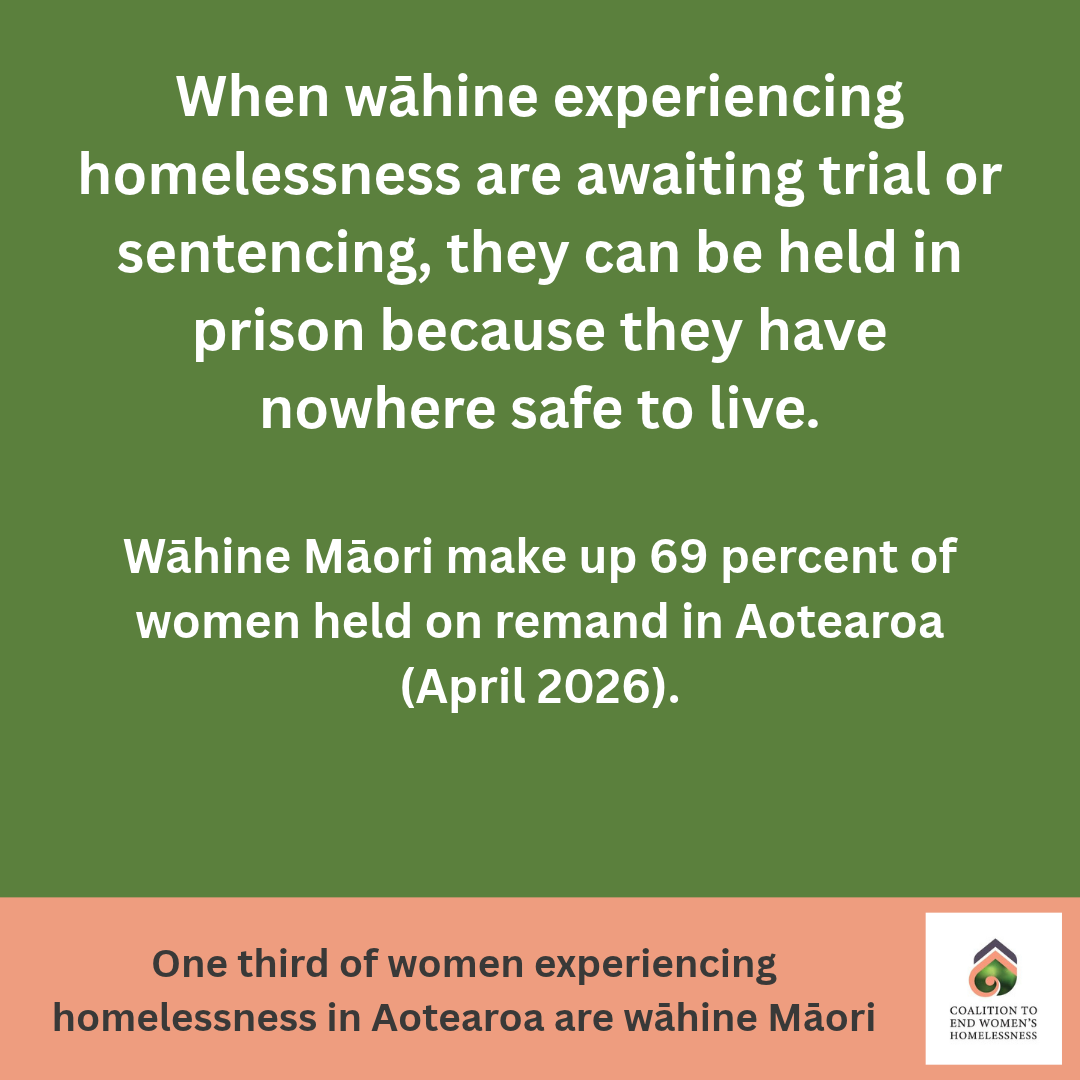
Wāhine Māori are overrepresented throughout the justice system, and remand is no exception. As of April 2026, wāhine Māori made up 69 percent of women on remand.
Director of the National Youth and Justice Coalition Awatea Mita explained that many Māori are held in prison while awaiting trial or sentencing because they have nowhere safe and suitable to live if granted bail. Mita described custodial remand as an expensive and destructive form of social housing.
CEWH's 2024 research, Ngā Ara ki te Kāinga, explores the relationship between women's homelessness and their experiences of the justice system. Imprisonment is itself a recognised driver of homelessness, with women leaving prison often facing significant barriers to securing housing, finding employment and maintaining relationships with their children and whānau.
But the relationship works both ways. Housing insecurity, poverty, family violence and other structural inequities can contribute to women's involvement with the justice system.
For wāhine Māori, these experiences cannot be separated from the wider impacts of colonisation, loss of whenua and culture, intergenerational trauma and systemic discrimination.
Homelessness and the criminal justice system
CEWH's Research Symposium, held in partnership with the University of Otago in March 2026, also explored the relationship between homelessness and the criminal justice system. Speakers highlighted how women's homelessness cannot be understood in isolation from family violence, colonisation, health inequity and intergenerational trauma.
The symposium also examined how criminalising homelessness and begging can create pathways into prison, including through fines that people cannot afford to pay.
These experiences and inequalities can shape the circumstances that lead women into homelessness, and make it harder for them to find a way out.
Community-led approaches are showing what practical support can look like
Matilda Kahotea, founder and director of Ngā Kete Wānanga Solutions, described a programme to RNZ that provides people on remand with somewhere to live, kai and practical wraparound support This includes help with medical appointments, identification, licences and addiction support.
The RNZ article also shares the experience of Waitangi Tribunal claimant Kelly Hume, who spent 16 months on remand before being found not guilty. It took three and a half years for her case to reach trial. Hume now supports whānau involved in the justice system, including people on remand, at Best Care Whakapai Hauora in Manawatū. She says she continues to see others experiencing the same circumstances she went through.
The TIAKI project
In a recent opinion piece on Newsroom, researchers from the University of Otago's TIAKI project, which examines the health and wellbeing of Māori leaving prison and their whānau, highlight the scale of Māori imprisonment in Aotearoa. They describe it as a legacy of colonisation, coloniality, white supremacy, racism and discrimination. They point out that mass imprisonment inevitably leads to mass re-entry into communities.
Māori who took part in the research described leaving prison without some of the most basic necessities, including housing, kai, transport and employment. Corrections has itself acknowledged that it does not know how many people leave prison with nowhere to go.
The researchers argue that the Government has obligations under Te Tiriti o Waitangi to do better. Their policy paper sets out a number of recommendations, including:
Increase the Steps to Freedom grant: The current one-off payment of $350, which not everyone is eligible for, should be increased to reflect the actual costs of returning to the community.
Improve access to safe, secure housing: MSD, Corrections and housing agencies should work with community housing providers, including iwi, hapū and Māori organisations, to secure safe, high-quality housing for people leaving prison.
Repeal the move-on orders legislation.
Housing must be part of the justice response
These links between homelessness and the justice system make it clear that access to safe, stable housing must be recognised as an essential part of our justice system, not treated as an issue to be addressed separately.
This means tackling the structural inequalities that contribute to homelessness and increase the likelihood of women coming into contact with the justice system.
