
Marking one year since the release of Ngā Ara ki te Kāinga: Understanding Barriers and Solutions to Women’s Homelessness in Aotearoa
The world we want to live in is a world where all women living in Aotearoa have a great place to call home and where our housing and social support policies take an intersectional approach to the experiences of women. However, the world we currently live in is one where too many of our women are unhoused, unnoticed, and unsafe.
Over the past year, the release of Ngā Ara ki te Kāinga, and the tireless advocacy of many around the country, have shone a spotlight on these challenges and helped spark meaningful change.
The December 2024 release was a major milestone for the Coalition - fostering new connections, energising CEWH’s advocacy, and opening up important conversations across the sector.
Ngā Ara ki te Kāinga served to corroborate what anecdotal evidence was showing the Coalition and those in the sector. We know that there are many more women homeless than those who are visible, and that there is an increase in housing deprivation as women age.
In the last year, the research has unlocked conversations about the importance of gender disaggregated data, which has resulted in a better snapshot of some types of housing, including transitional housing.
Ngā Ara ki te Kāinga also aligns with research from University of Otago and Te Whāriki Manawāhine O Hauraki that showed that younger women and their children are significantly impacted by homelessness, and that family or sexual violence often plays a role.
Sharing the research has served as a valuable launch point for CEWH communications and policy discussions with politicians, the Social Investment Agency, HUD, and the sector. It has provided the Coalition with the ability to partner across the sector to strengthen knowledge sharing and collaboration, through work on projects such as the National Homelessness Data Project and with other advocacy organisations.
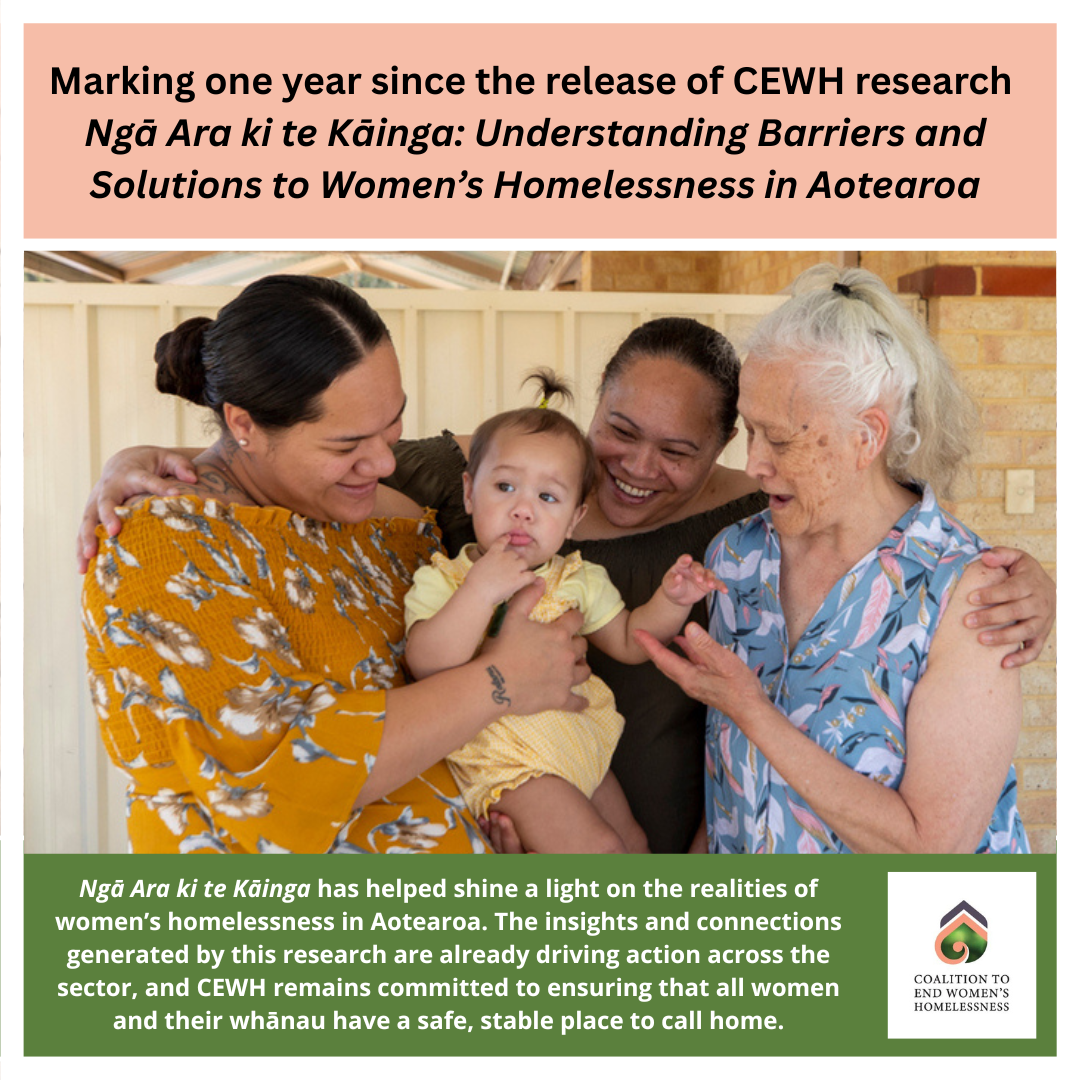
Ngā Ara ki te Kāinga has helped shine a light on the realities of women’s homelessness in Aotearoa. The insights and connections generated by this research are already driving action across the sector, and CEWH remains committed to ensuring that all women and their whānau have a safe, stable place to call home.
