
February 2026 pānui
Ka pinea koe e au
Ka pinea koe e au,
Ki te pine o te aroha,
Ki te pine e kore nei,
E waikura e.
I will pin you (to me),
With the pin of love,
With a pin that will never rust away.
The waiata Ka pinea koe e au is a waiata tangi, a lament. It expresses a heartfelt promise about everlasting connection. The phrase “e kore nei e waikura” refers to a "pin that will never rust" - a metaphor for an eternal bond.
We open this newsletter with a waiata tangi as a tribute to those lost at Mauao during the recent slip. The Coalition to End Women's Homelessness joins with others to pay our respect to the six people who lost their lives in the slip.
Hoki wairua e kui mā e koro mā kei tua o te arai e.
We extend our heartfelt sympathy to the whānau pani at this time.
To the whānau made homeless, and the communities devastated by the recent flooding in other parts of the country, particularly Te Tai Tokerau and Te Tai Rāwhiti - he mihi aroha.
You face long roads to recovery. The rebuilds needed raise fundamental questions about regional infrastructure, cultural capability in Civil Defence and Emergency responses, and this country's response to climate change.
Me mahi tahi tātou ki te whāia ngā huarahi tika!
Collaboration will be critical as we seek sustainable futures.
————————————————————————————
Even at this early point in the year, January has been a busy time for those providing frontline services, with significant activity and important conversations underway. The pace reminds us that the need for collaboration, shared learning, and collective action remains as strong as ever.
Our strength lies not in individual efforts, but in working together and we look forward to connecting with you and continuing to work alongside you in the months ahead.
Nāku noa,
Kathie Irwin and Victoria Crockford
Kaihautū and Project Director
Coalition to End Women’s Homelessness
WAKA HUIA

Kathie Irwin’s personal Waka Huia.
Send our Open Letter: Calling for a Te Tiriti-based national strategy to end women’s homelessness in Aotearoa
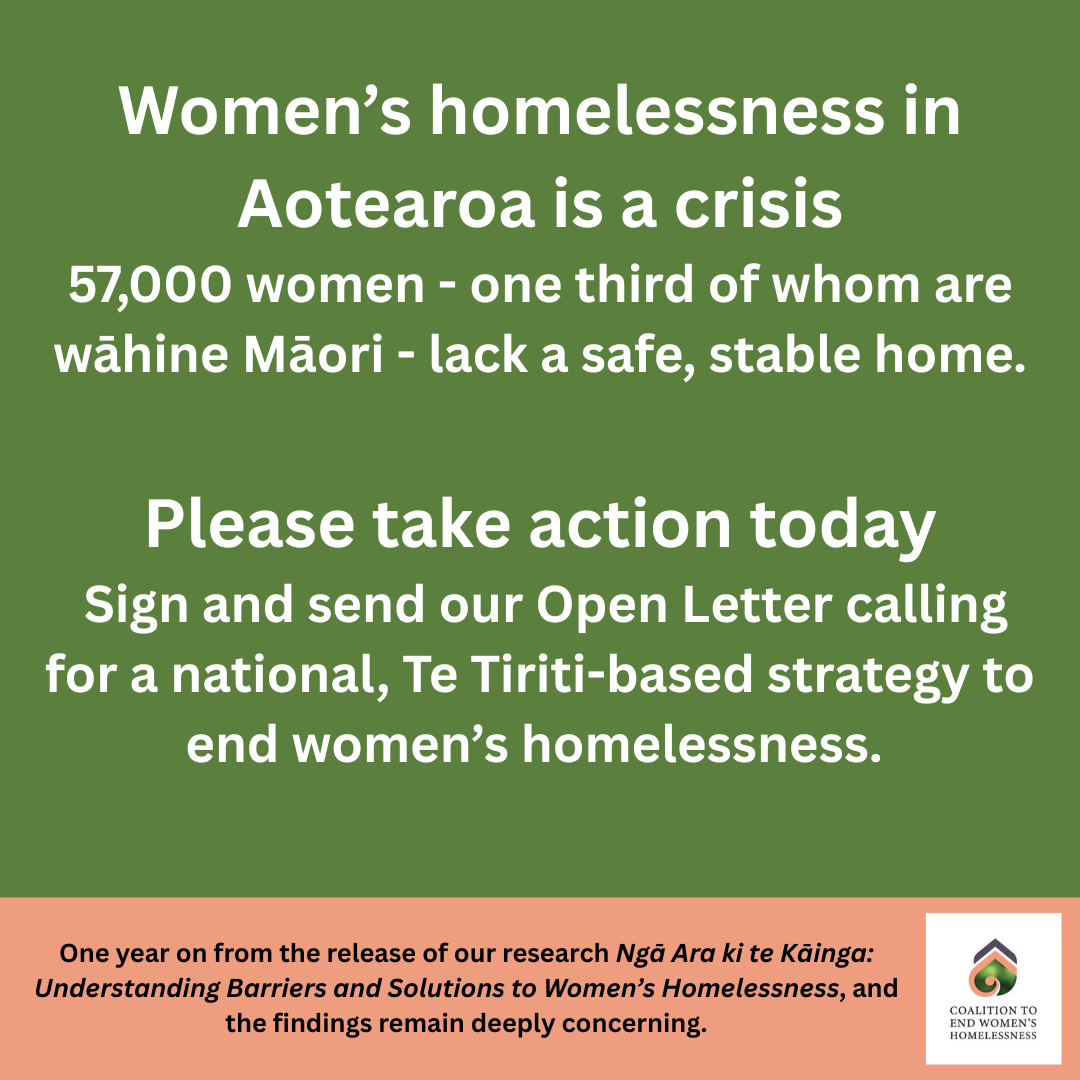
In December 2025 we marked one year since releasing our women’s homelessness research Ngā Ara ki te Kāinga: Understanding Barriers and Solutions to Women’s Homelessness in Aotearoa.
As the 2026 General Election approaches, we are asking our sector colleagues and members of the public to add weight to a shared call for change: sign and send our Open Letter, which calls for a national, Te Tiriti-based strategy to end women’s homelessness.
Find out more about our Open Letter here.
When we released the Open Letter, CEWH Kaihautū Kathie reflected that people often ask: “Why women's homelessness? What about the men?”
Kathie says that homelessness is a critical social issue we must address as a caring society.
“Our December 2024 research found that women make up fifty percent of homeless whānau. Māori women were one third of the homeless women. Grossly, disproportionately, over-represented,” she says.
Kathie highlights features of women’s homelessness that require unique solutions:
Safety at night: Nights are not safe for women on the street. Kathie herself doesn't go for a walk at night anymore. “If it is not safe for women to walk at night, you can understand that it is not safe for women to sleep outside in public places at night.”
Impact of violence: Women’s experience of domestic, sexual, and intimate partner violence makes mixed facilities problematic.
Mothering and wellbeing: Women have health and well-being concerns which are specific to Te Whare Tangata, mothering and caring for children. “I have two children, two years apart, both of whom were caesarean deliveries. I know how challenging those years were for me with the resources I had available,” Kathie says.
Economic precarity: Gender and ethnic pay inequities impact women differently over time. “The impact of pay inequity compounds negatively over time meaning that single, older women face growing economic and housing precarity as they age,” she says.
Kathie notes this is not an exhaustive list. A broader range of research-based resources exploring women’s homelessness is available on our website.
No holiday from homelessness: Women and their children unhoused in Aotearoa

This summer, we ran a mini campaign highlighting the urgent reality that for many women and their children - there is no holiday from homelessness in Aotearoa.
We shared the story of Waimarama, who took part in our research. Emergency housing gave her and her young whānau a warm place to sleep, but the complex was extremely unsafe. At times, she had to stay in a tent or shed because it was too dangerous for her and her baby.
CEWH Project Director Victoria Crockford drew on her own experience to reflect on the challenges for women like Waimarama navigating motherhood in unsafe housing:
“I remember being a new mum. It is a wonderful and overwhelming experience. I can't imagine being a new Mum navigating unsafe and insecure housing, like Waimarama. She is one of many women with kids experiencing a housing system that is stacked against them,” Victoria said.
Find out more about women and their children experiencing homelessness here.
Webinar recording and resources now available: Lunchtime Learning
Understanding Homelessness: Wāhine Māori lived experiences of rough sleeping in Wellington City and their safety needs
Last week, CEWH hosted our Lunchtime Learning webinar about this qualitative project led by Kaupapa Māori researchers, for Wellington City Council.
Watch or listen to the webinar, download the slides and read the research here.
Please share with friends, whānau, colleagues, and peers.
Ngā mihi nui to Millie Lambess (Ngāti Kahungunu), Harm Prevention Team Lead at Wellington City Council, and Nan Wehipeihana (Ngāti Tukorehe, Ngāti Raukawa, Ngāti Porou and Te Whānau a Apanui), Director at Weaving Insights for generously sharing your time, insights, and commitment to this kaupapa, and to Dr Kathie Irwin for facilitating the kōrero and holding space with care.
You’re invited to our next Lunchtime Learning webinar: Kei te rongo koe? Are you listening?
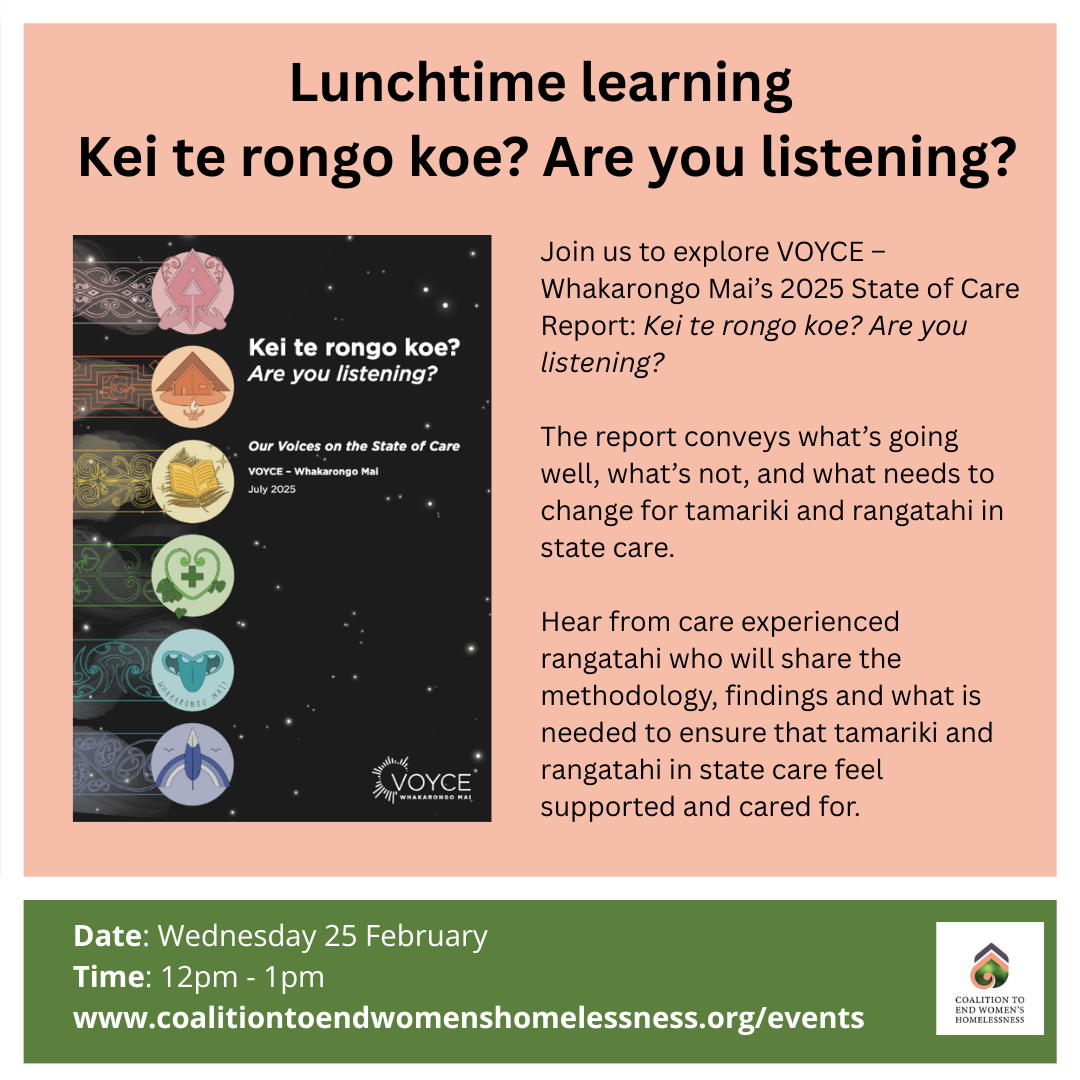
Last year, VOYCE – Whakarongo Mai released their State of Care Report 2025 Kei te rongo koe? Are you listening? The report conveys what’s going well, what’s not, and what needs to change for tamariki and rangatahi in state care.
This report is about whether tamariki and rangatahi feel cared for.
Hear from care - experienced rangatahi Ihorangi Reweti Peters (Ngāti Tūwharetoa, Ngāti Tahu-Ngāti Whaoa, Waikato, Ngāti Kahungunu), Lisa McLaren, Kingi Palmer and Abigail Bramwell with support from VOYCE kaimahi Cameron McKay (Ngātiwai, Ngāti Porou) and Tayla Taylor.
Date: Wednesday 25 February 2026
Time: 12–1pm
Location: Online | Free
Registration details: Here
Read VOYCE’s report Kei te rongo koe? Are you listening? Here
We hope you can join VOYCE and CEWH in February.
AROUND THE SECTOR
New CEWH sector blog
This is the first in a new monthly blog series by CEWH Kaihautū Dr Kathie Irwin, Project Director Victoria Crockford, and Collective Impact Lead Amanda Kelly.
A core part of our mahi is ongoing engagement with iwi, organisations, leaders, and community groups working in the sector. These relationships shape our work at CEWH every day. This monthly blog shares reflections on what we are seeing across the sector, including the work we are engaging with and learning from.
Read this month’s blog here.
Quick links
Here’s a roundup of news, research, and sector updates that caught our attention this month.
We hope these links provide useful insights and spark kōrero across our community.
Waatea News: Homelessness Worsens in Aotearoa – And Māori Communities Are Bearing the Brunt
Waatea News: #national Government Activates Accommodation Support for Severe Weather Displacement
RNZ: Government to offer temporary accommodation to storm victims
NZDF: New Zealand Defence Force assisting recovery efforts on East Coast
Te Ao Māori News: $1 million fund to reimburse ‘exceptional’ marae response - Prime Minister
Scoop: Oriini Kaipara: Prime Minister’s ‘Progress’ Ignores Housing Crisis Facing Māori And Rangatahi
Waatea News: Homelessness Surges Under Government as Māori Whānau Feel the Impact
Te Ao News: Hawke’s Bay Māori housing project wants to see the model rolled out nationwide
The Beehive: Affordable homes for families in Porirua
Newsroom: How Māori design is reshaping housing
RNZ: Homelessness in Auckland more than doubles to 940 people in year to September - survey
The Spinoff: How the pay equity ‘reset’ erased years of progress for Pacific communities
POLICY AND POLITICAL INSIGHTS
CEWH submission on proposed data collection approach and content for the census
At the end of 2025, CEWH made a submission to Stats NZ on the proposed data collection approach and content for the census. CEWH is clear that housing policy and investment must be guided by robust, comprehensive, Tiriti informed gender disaggregated data.
Read our submission here.
He iti te mokoroa, nāna i kati te kahikatea
The grub may be small, but it cuts through the kahikatea
Vic, Kathie, Amanda, Ellie, Helen, Jo, Caroline, and Jill
