
Whakawhanaungatanga in Tairāwhiti: Dr Kathie Irwin on taking child homelessness research home
Dr. Kathie Irwin (Ngāti Porou, Rakaipaaka, Ngāti Kahungunu) is Kaihautū of Coalition to End Women’s Homelessness
Briefing the Tairāwhiti Gisborne wāhine Māori iwi leaders on the new Coalition to End Women’s Homelessness (CEWH) research headlined 'Over 33,000 children in Aotearoa are having their childhoods shaped by severe housing deprivation causing lasting harm” presented us with real challenges.
The data in our research Children and Young People Experiencing Homelessness was the result of a deep dive into the same 2023 IDI data that found that around 57,000 women are homeless in Aotearoa. This was identified in our December 24 research Ngā Ara ki te Kāinga Understanding Barriers and Solutions to Women’s Homelessness in Aotearoa.
The report finds that young people experiencing homelessness are more likely to live in Gisborne, Auckland or the Northland region than the comparison group
CEWH has more capacity in Auckland so whilst the Auckland and Northland briefing opportunities had their own issues, we as a coalition also have more organisational connections on the ground and capacity to manage them.
My stomach dropped when I realised that Gisborne was one of the areas our new research highlighted and that I would need to front the embargoed briefings and ensure our Tairawhiti wāhine had a chance to consider the research early.
Why did my stomach drop?
1. CEWH is not 'kanohi kitea' in Gisborne in ways that we are in other places. Individuals may be - but not the Coalition itself. In Māori engagement step one is relationship building before transactional business is attempted.
2. We run the risk of appearing to behave like the dreaded seagulls local Ngāti Porou bemoan - often a descriptor associated with Crown agencies and government departments - the 'seagulls' who fly overhead, drop buckets of sh#t and fly away. Taking no responsibility for the impact of the drop or the clean up afterwards.
The first iwi leader I spoke to said the research was not news, at a high level, and it was why they were designing the pro-active initiatives that they are in housing.
3. We needed to take care how we were positioning this research so that we didn't inadvertently make it appear as if we were holding iwi, community and local government responsible for a social issue created by the State at the structural level and positioned historically decades ago.
4. We needed to manage the research release through The Papatūānuku Paradigm, the CEWH gender analysis toolkit, which meant:
* Past: Finding out the local back story to Houselessness / Homelessness in the area;
* Present: Ensuring local wāhine leaders, working on the ground, had the embargoed research early so that they could speak to it if asked.
5. Knowing the locals and regional demographics - the local Māori population was about 54% at the 2023 census compared with 17% nationally. That is about three times the national demographic profile. The Māori population is also younger than the NZ population by about ten years. Both demographic features may have been factors in why the Gisborne stats stood out in the research as they did.
* Future: Giving a strengths based, solutions focussed update on what local initiatives are being developed to create better outcomes. There are significant developments in housing being built right now that will have strong regional impact. We need to be able to highlight those initiatives so that we see and acknowledge the strategic vision the local iwi / community is building.
In summary: our research needed to be shared, softly in context: a historical, structural, Tiriti centric context.
Feeling aroha for Te Tairawhiti is not hard. The region is geographically off the beaten trail of the normal ebb and flow of New Zealand society - you don't just happen to arrive in Gisborne or just be driving through. You arrive in Gisborne because you are going there, on purpose. The region faces the challenges of being out on a limb.
It has also been hit hard by catastrophic climatic events in recent years, adding particular dimensions to homelessness, not shared by everyone in other regions of the country.
The area faces particular economic and social challenges which together speak to a regional economic fragility.
It is also the first place to see the sun in the morning each day. As a region there is a Māori cultural infrastructure that is tightly connected and highly functional. There are 48 marae in the Ngāti Porou takiwā. When Ngāti Porou settled its Tiriti Settlement with the Crown, its cultural redress package included resources to put every Ngāti Porou marae online, connected to free Wi-Fi. Wāhine Māori leadership in the region is historically exemplary and this plays out in many contemporary settings. Like housing, through Toitu Tairawhiti housing projects (Annette Wehi and Kararaina Cribb), local government (Deputy Mayor, Aubrey Ria, Counsellors Rhonda Tibble and Anne Haenga, and CEO, Nedine Thatcher, are all local Ngāti Porou women). The region has strong Māori medium education, Toi Māori and Kapa Haka presence. Kōhanga Reo, Kura Kaupapa Māori and Kura-a-Iwi, are now led by second generation whānau who are graduates of these programmes now holding leadership positions.
I spent a few days at home, on the ground in the week before the research was due to be released, engaging in whakawhanaungatanga, catching up, attending local iwi wānanga.
Wednesday June 3rd was a big Wānanga-a-iwi day.
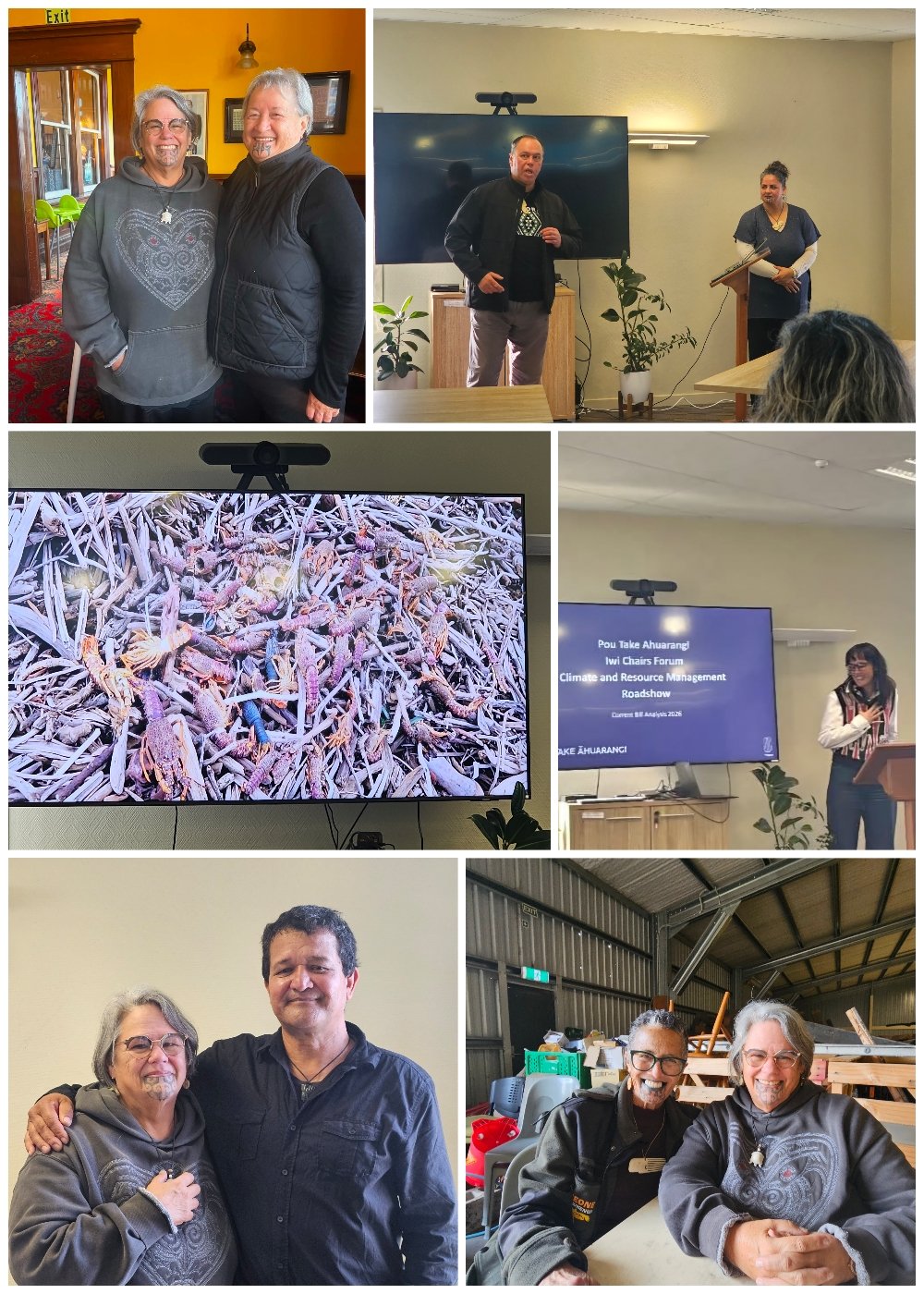
First up, I had a hui with Vyletta Arago-Kemp (photo below: top left) now home, a long standing researcher / public servant having worked at NZCER, the Families Commission and Te Taura Whiri i te Reo Māori. We talked about current research in the area.
Aatea Consultants Ltd (AATEA Solutions), Kiwa Hammond and Hinerangi Edwards ONZM opened the second wānanga with Kanapu, CEO Poia Rewi Rewi and team presenting on their work. The Kanapu breadth and depth of offerings is very impressive. Research can be a tough gig without the university institutional support. Kanapu offers a unique structural / value add.
Graeme Atkins (photo below: bottom left) addressed Climate Resilience, featuring over thirty years of his exemplary work in Te Taiāo throughout the region. The photo on the left in the middle row is of slash after a cyclone, with dead crayfish and paua washed up on it. It was devastating listening. Having a photo with Graeme felt like being in Vegas, with Elvis! He is a legit Taiāo rock star!
Tina Porou (photo below: middle right) followed with a National Iwi Chairs Forum Climate and Resource Management Roadshow. Tina called on lived experience / praxis through operational, management and governance issues in both Tiriti and Treaty contexts. Across generations, iwi, organisations and sectors. The crushing points of Crown / government impact were outlined and analyzed with a deftness that was equally instructive and impressive.
Then Charlotte Gibson and I met with a local journalist to share the Ngāti Oneone pūrākau and their recent land occupation as part of the back story to our new research coming out the following week.
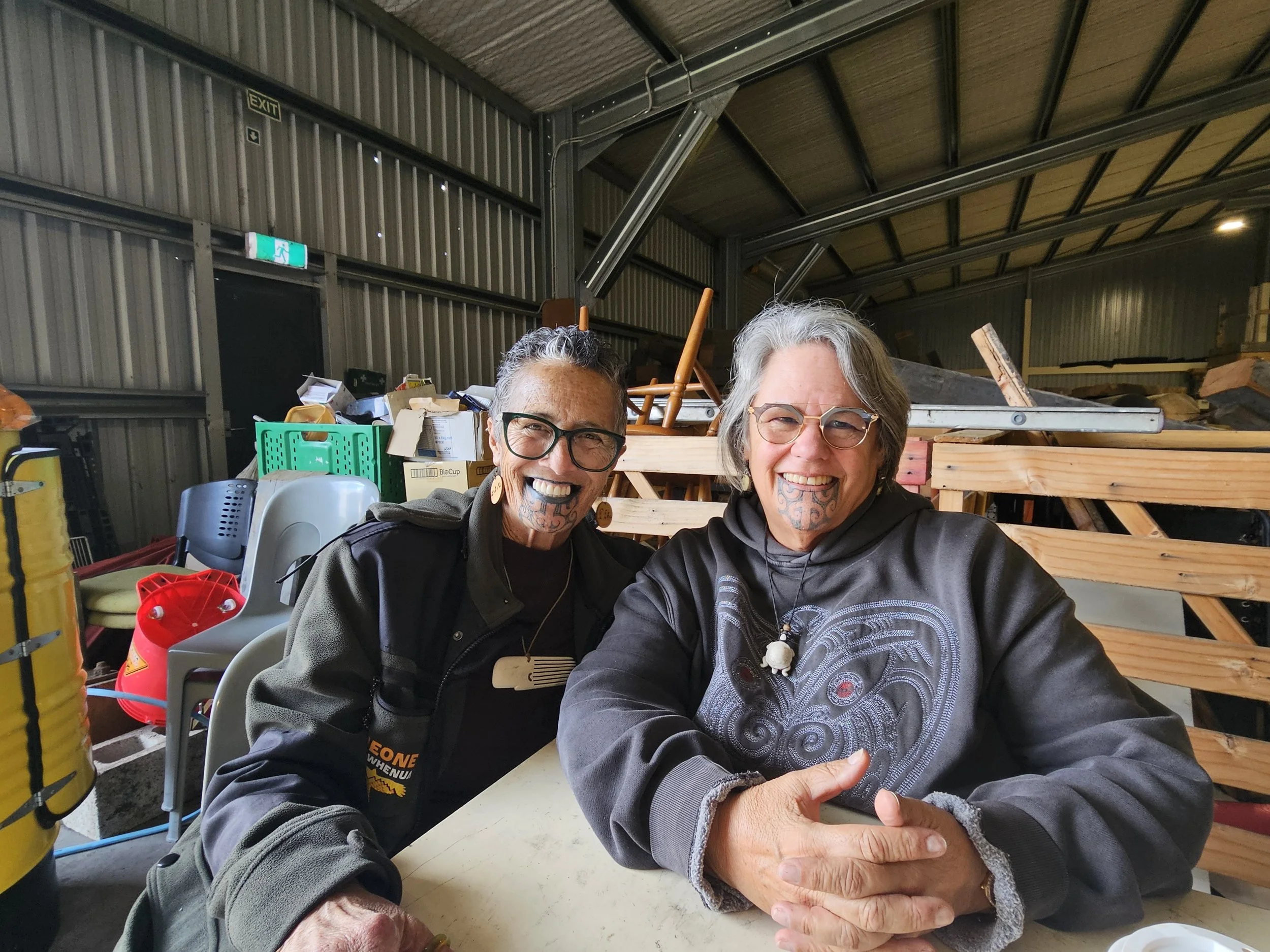
Charlotte shared the history behind the hikoi and occupation, including discussion of a 1927 Gisborne City Council By-law which stipulated that Māori had to be across the river by 6pm. A 'move on order' to homeless Māori 100 years ago! She talked about Ngāti Oneone being the only landless hapū of Ngāti Porou and how deeply that cut. The land activation she led was an inter-generational struggle. She shared work her father did to get the land, wrongfully taken, back. The huge shed we met in is one of the land blocks/ resources returned. You can see it in the background of this photo with Charlotte.
Charlotte's leadership is legendary. She is the Chair of the hapū, the marae Te Poho o Rawiri and is active in Te Kōhanga Reo, Māori Medium Education, Kapa Haka and whānau, hapū, iwi and community development. She is also the loving mother of the Gisborne District Council Deputy Mayor, Aubrey Ria!
The Papatūānuku Paradigm, the CEWH gender analysis toolkit, includes design principles from the Māori worldview which this day of hui and wānanga confirmed:
1. The need to surface the worldview services are designed from;
2. The unique characteristics of Māori knowledge and their innovative nature;
3. The need for structural analysis in policy work;
4. The embeddedness of Te Tiriti in public policy;
5. The role of the Māori Cultural Infrastructure in Aotearoatanga, nation building;
6. The impact of wāhine Māori leadership in our communities.
I drove for this trip: from Ōtaki to Taupo, Te Teko, Whakatane, Opotiki, Te Kaha, Gisborne, Wairoa, Hastings, then home to Ōtaki.
Getting out of the Wellington bubble is critical to feel the pulse of the people, to be in Te Tāiao witnessing the devastation caused by climatic events and in wānanga-a-iwi.
Though not exhaustive, this is critical local intel which bodes well for the 'so what' and 'what now' post research possibilities.
People are on the ground actively mobilizing to build the futures they want for their region and people.
And that includes ending women and children's homelessness.
