
Whakaata Māori - Rangatahi and tamariki Māori battle the worst for severe housing deprivation
On June 8 2026, we released research showing that 33,192 children in Aotearoa are experiencing homelessness.
These children are more likely to live in Tairāwhiti, Tāmaki Makaurau, and Te Tai Tokerau, and Māori and Pasifika children are disproportionately represented among them.
In December 2024, we released research showing that women make up more than half of Aotearoa’s homeless population - 57,000 women, one-third of whom are Māori.
These figures are not separate. Our research shows that you cannot separate children’s homelessness from women’s homelessness. When mothers do not have access to safe, stable housing, their children are directly impacted.
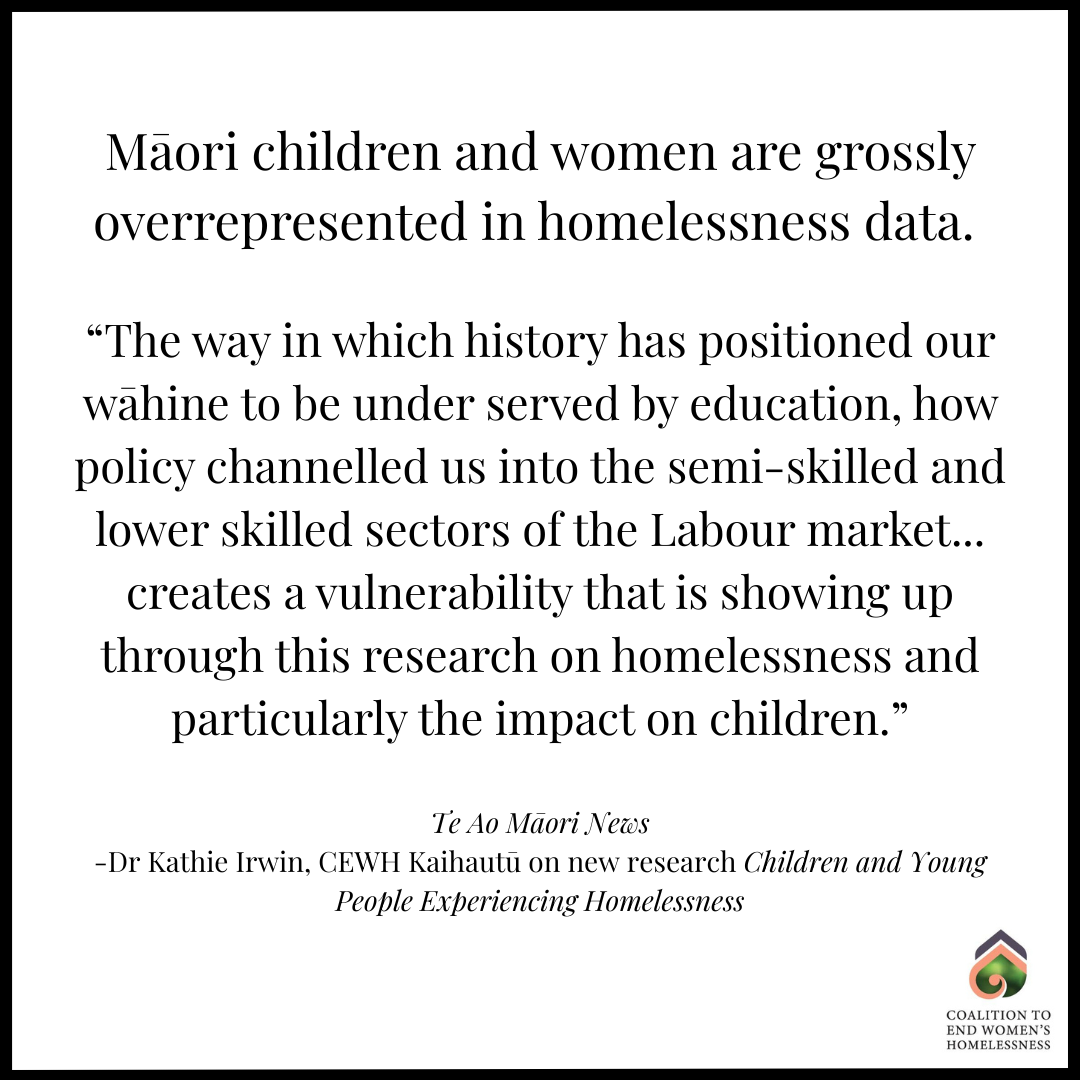
As Harata Gibson of Ngāti Oneone tells Te Ao Māori News, the loss of hapū land in Tūranganui-a-Kiwa in the Tairāwhiti region, was the beginning of the homelessness seen in the area today.
Understanding who is experiencing homelessness, and why, requires us to understand the historical and structural forces that have shaped housing insecurity across generations.
Ngā mihi nui Anastasia Manza at Whakaata Māori for telling this story, and to Harata Gibson, Dr Kathie Irwin, MNZM, Pūkenga Rangatira, MInstD, Bianca Johanson at Manaaki Rangatahi, and Chris and Kerrin Leoni at Mā Te Huruhuru for working so hard, every day, to change the long tail of this story and create better outcomes for whānau experiencing homelessness in Aotearoa.
📺 Read and watch this story on Te Ao Māori News here
📖 Read our research Children and Young People Experiencing Homelessness here
✊🏽 You can take action - sign and send the CEWH Open Letter, which calls for a national, Te Tiriti-based strategy to end women’s homelessness here
