
International Indigenous Peoples Day 2026: Dr Kathie Irwin’s First Year as Kaihautū
Blog by CEWH Kaihautuū Dr Kathie Irwin
International Indigenous Peoples Day in 2026 coincides, give or take a couple of days, with the one-year anniversary of my taking up the role of Kaihautū at the Coalition to End Women's Homelessness (CEWH).
So I thought I would take some time out to look back over my first year in the role, and at the journey that brought me here.
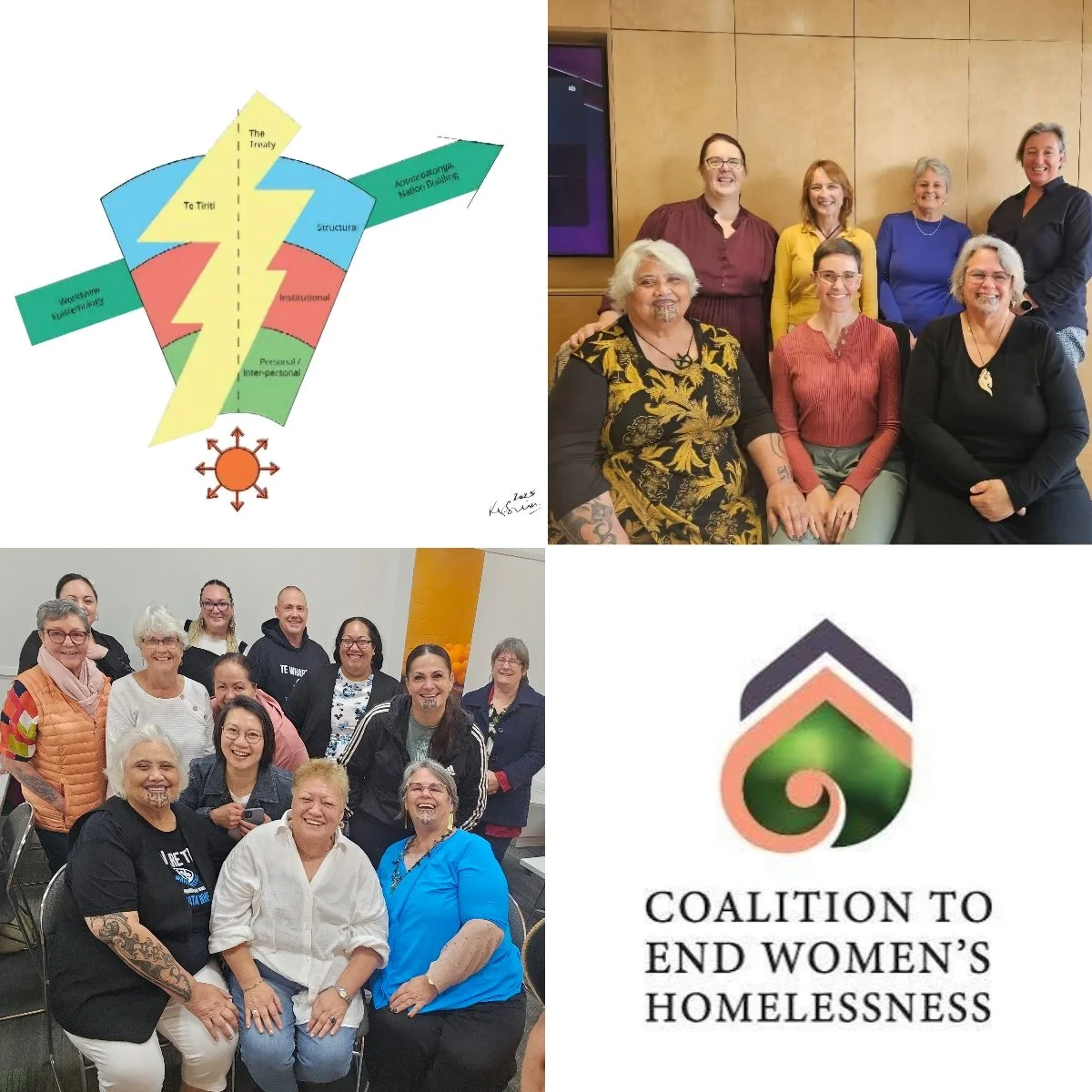
Image credits: Top left, The Papatūānuku Paradigm
Top right, Te Tira Whakahaere CEWH
Bottom left, Kaimahi, Te Whare Tiaki Wahine Refuge Porirua
Bottom right, logo, Coalition To End Women's Homelessness
Women's homelessness is a structural issue
In December 2024, CEWH published Ngā Ara ki te Kāinga Understanding Barriers and Solutions to Women’s Homelessness in Aotearoa. The research found that over half the homeless whānau were women; a third of the women were Māori women. This figure is a gross over-representation.
Homelessness is a critical social issue facing Aotearoa. But women's homelessness has particular characteristics that demand gender-responsive approaches:
Women experiencing homelessness are more likely to have experienced intimate partner violence, domestic violence and sexual violence. These experiences make women-only services vital and can deter women from sleeping rough in public, making women's homelessness less visible.
Women are more likely to experience economic precarity arising from gender and ethnic pay inequities, the effects of which compound over a lifetime. They are more likely to carry child-rearing and wider whānau responsibilities. And they have particular health, safety and personal-hygiene needs.
These are not simply individual circumstances.They are shaped by systems.
Developing The Papatūānuku Paradigm
I developed The Papatūānuku Paradigm, a gender analysis tool to end women's homelessness, for CEWH at the invitation of Dr Jo Cribb who is on the CEWH steering committee and is Chair of Te Whare Nukunoa - Wellington Homeless Women's Trust.
Jo and I have a long working relationship. We were colleagues on the Senior Management Team at the Families Commission from 2010–2013 and have stayed in touch ever since.
When Jo first approached me about developing the tool, I said no. I thought the project timeline was too tight and the resource base too small to do the work justice. I suggested several other researchers who might be interested. Jo contacted some of them, and a number of them suggested me, and in the intervening time I realised: ‘I can do this’.
This was another application of the Indigenous systems methodology I have developed over many years, with foundations in the theory chapter of my PhD. I rang Jo back and said ‘yes’.
In June 2025, after the drafting of the tool, we tested it at Auckland City Mission – Te Tāpui Atawhai and Te Whare Tiaki Wahine Refuge Porirua before we landed on the final version. The Papatūānuku Paradigm is the tool.
The Papatūānuku Paradigm was born.
Changing the lens
The Papatūānuku Paradigm locates policy analysis epistemologically, historically, structurally and institutionally before considering personal issues. That sequence matters.
It enables us to identify the full range of determinants contributing to public policy outcomes.
Without such an approach, outcomes such as women's homelessness can too easily be examined through a deficit lens which ultimately holds individuals responsible for public policy outcomes created by the state.
We hear explanations about women experiencing homelessness, such as:
"She didn't save enough."
"She didn't work hard enough."
"She isn't very bright. She didn't do well at school."
Thinking like this absolves the state of its role in creating and perpetuating inequality.
If we want different outcomes, we need to ask different questions.
From theory to praxis
When the Kaihautū role was subsequently advertised, with responsibility for implementing and evaluating The Papatūānuku Paradigm, I thought: ‘I can do that’.
In August 2025 I took up the role and became Co-Project Lead alongside Victoria Crockford, working ten hours a week. Sixty per cent of my role has a policy and advocacy focus.
Over the past year our work has moved The Papatūānuku Paradigm from theory, to tool, to testing, to implementation, to policy advocacy and sector application.
Building the knowledge base
We have produced a series of short videos explaining The Papatūānuku Paradigm in accessible, bite-sized pieces, and a training manual is being developed to support organisations and groups to use the videos for professional learning, informed by Māori pedagogy.
In October 2025 we hosted a webinar on the tool, the video is available here.
In March 2026 CEWH and University of Otago – Ōtākou Whakaihu Waka hosted a Research Symposium in Wellington. Researchers from throughout the sector joined to present their research. I did a presentation on the tool. The Symposium Report is due to be released by our team in the coming days.
Putting The Papatūānuku Paradigm into practice
We are exploring Communities of Practice using The Papatūānuku Paradigm with Auckland City Mission – Te Tāpui Atawhai, Te Whare Tiaki Wahine Refuge Porirua and Te Taiwhenua o Heretaunga.
CEWH Project Director Victoria Crockford and Collective Impact Lead Amanda Kelly also used one of the Papatūānuku Paradigm videos in the CEWH workshop at the Community Housing Aotearoa Conference in June 2026.
The tool is increasingly being applied beyond homelessness
The CEWH submission to the People's Select Committee on Pay Equity drew on The Papatūānuku Paradigm.
I have completed an analysis of the 2025 Review of Retirement Income Policies using the tool. The paper is available by emailingkathie@cewh.org with "Copy of RRIP2025" in the subject line.
I am also currently advising the New Zealand Council of Trade Unions Working Women's Charter Review using The Papatūānuku Paradigm.
This matters because women's homelessness cannot be separated from women's economic lives - pay equity, housing, employment, violence, health, caring responsibilities and retirement income are interconnected systems.
Taking the conversation further
In October 2025, I was invited to deliver a keynote address at the Te Matapihi National Māori Housing Conference at Waitangi. I called my address Aotearoatanga, Compound Interest, Compound Impact: The Back Story to Inequality.
In April, I had a chance to attend Women Deliver 2026 in Naarm Melbourne. We began by honoring where we stood, on the unceded lands of the Wurundjeri Woi Wurrung Peoples of the Kulin Nation. Led by the Wurundjeri Woi Wurrung Peoples, a Welcome to Country was offered by First Nations Elders as an acknowledgement that we met on unceded land, inviting us to move with humility and respect.
The event was structured around four action-oriented pathways to guide discussions:
Disrupt the Now: Confronting systemic injustices and reclaiming power.
Build the Vision: Imagining alternatives and redesigning care-centered systems.
Align for Action: Forging cross-movement alliances.
Sustain the Movement: Securing long-term resources and intergenerational accountability.
Although the Women Deliver conference is more than twenty years old, this was the first conference led by Indigenous women. Local Aboriginal women from Naarm opened and led the conference . Mele Wendt, Louisa Wall, Prue Kapua and Mereana Hond were among those who played significant roles from the Pacific and Aotearoa.
While in Melbourne, I was also invited to lecture at the Indigenous Students Centre at the University of Melbourne. Associate Professor Jessa Rogers extended the invitation and generously hosted my whānau and me during our stay.
My lecture included the work of CEWH and The Papatūānuku Paradigm. An Indigenous systems methodology developed here in Aotearoa to help understand women's homelessness was entering an international Indigenous conversation.
And then there are the children
In June this year, the CEWH releasedChildren and Young People Experiencing Homelessness. Over 33,000 children were identified through their connections with women identified as experiencing homelessness in our CEWH December 2024 research.
The area with the highest rate of children’s homelessness is Gisborne. I have whakapapa links to Ngāti Porou so I made a point of being home alongside local iwi leaders - meeting and briefing them on the research (read my blog about this here). There was considerable media interest in the research.
Houseless on our own whenua
We have now brought Te Rina Porou into the CEWH team part-time to work alongside me on a new project briefing local government, iwi and NGO leaders about women's and children's homelessness. We are beginning in Gisborne.
For wāhine Māori, intersectionality is not an abstract academic concept. The overlapping impacts of multiple sites of structural inequality are lived realities. Colonisation, Capitalism, Patriarchy, Racism, Gender inequality, Economic inequality, Systems of unequal relations.
Their impacts accumulate across generations, institutions and public policy systems. They appear in pay packets, housing markets, experiences of violence, health outcomes, caring responsibilities and retirement incomes.
And ultimately they appear in who has - and who does not hav - a safe place to call home.
Too many wāhine Māori are houseless on our own whenua.
On International Indigenous Peoples Day, that contradiction should stop us in our tracks.
Indigenous knowledge is not simply something to acknowledge, celebrate or include.
It offers different ways of seeing, different ways of asking questions and different ways of understanding systems. And therefore different possibilities for changing them.
That is what The Papatūānuku Paradigm is intended to do.
The structural inequality that creates women's homelessness has been designed in to public policy over decades. It is our mission at the Coalition to End Women's Homelessness to help design it out.
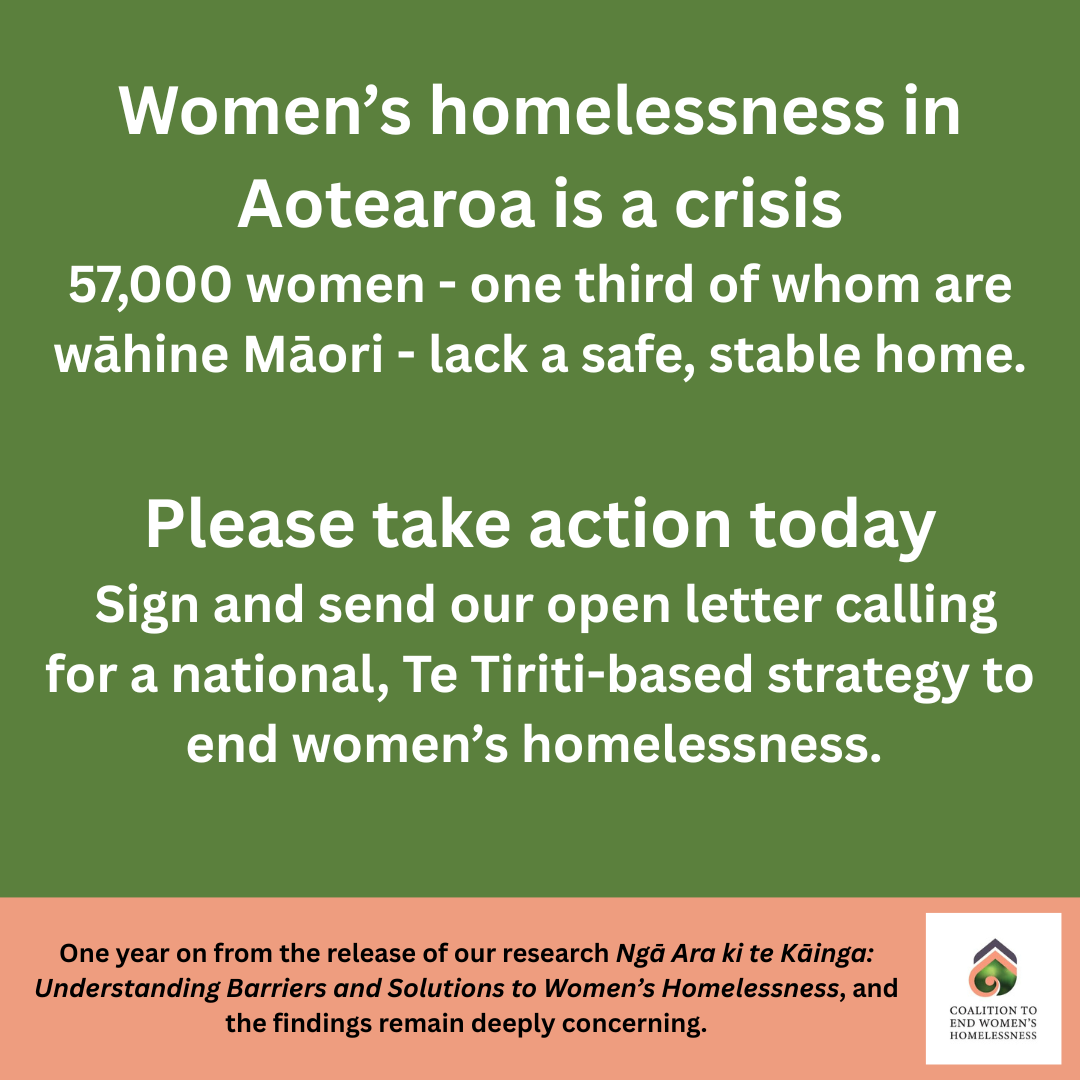
Join us in this work. It is urgent.
You can send our Open Letter - calling for a Te Tiriti-based national strategy to end women’s homelessness in Aotearoa.
